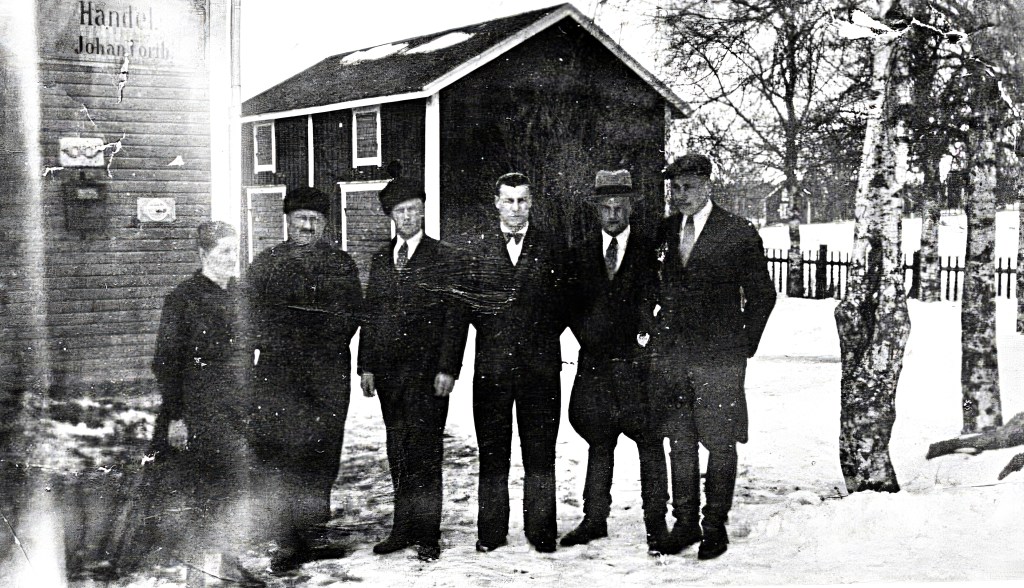
That’s how the newspaper described it. ‘Sprang rakt i armarna på vinkande ryssar´- ran straight into the arms of waving Russians. It’s the kind of detail that gets stuck. February 12, 1940. A crossroads called miljonkorsun (the million bunker – it cost at least a million to build) by the Swedish speaking soldiers, near Summa, on the Karelian Isthmus. The Finnish line was breaking. His unit had been in the field since October.
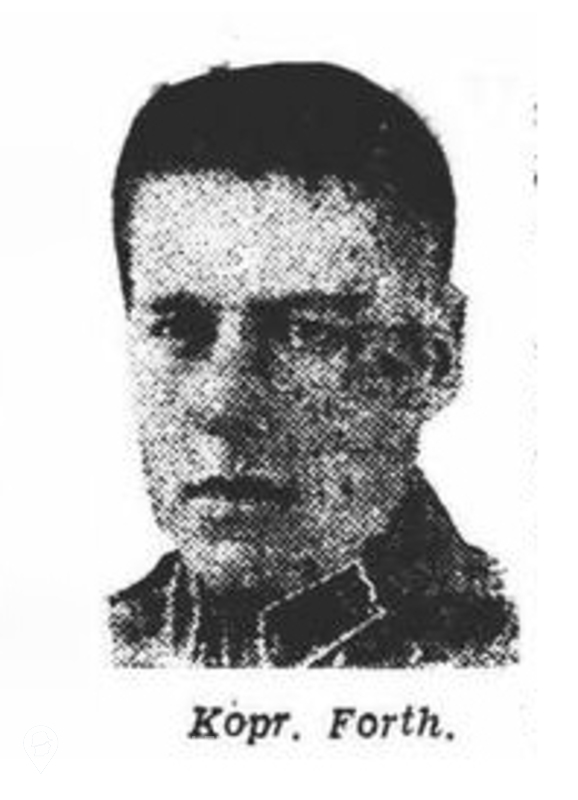
His name was Bengt Rafael Forth. He was 24. He came from Tölby, a small village in Korsholm, Ostrobothnia, on the west coast of Finland.
He was my grandfather on my father’s side.
The war he walked into
The Soviet Union attacked Finland on November 30, 1939, without a declaration of war. Rafael had been mobilized six weeks earlier, in October – the Finnish army had been quietly preparing since the negotiations with Moscow collapsed.
He served first in JR 22, then transferred on January 1, 1940 to JR 9, one of the regiments holding the Karelian Isthmus near Summa. This was the most pressured point on the entire Mannerheim Line. On February 1, the Red Army launched its main breakthrough offensive – massed artillery, thousands of tanks. JR 9 was directly in its path.
Twelve days later, he was captured.
What happened at the crossroads
In November 1943 – three and a half years after the events – the Swedish-language Finnish newspaper Vasabladet published a three-part interview series with Rafael under the headline I rysk fångenskap (In Russian captivity). The articles ran on November 17, 19, and 21. They’re the source for most of what I know about these months.
The scene at miljonkorsun is specific: Russian tanks behind them, trenches destroyed, a handful of men – Fänrik Skade is named, and soldiers Bengs, Holmberg, and Olin from Brändö. With most of their battle comrades killed, they gave up. They ran toward the Russians. There were soldiers in the hundreds waiting for them.
Within thirty minutes the pockets were empty. Camera, watch, wallet. A Russian officer reached into Rafael’s jacket, then pointed out that they hadn’t gotten the ring off his finger yet.
The Swedish speaker
What happens next says something about how systematic the Soviet propaganda apparatus was. A Russian lieutenant who spoke fluent Swedish took personal charge of Rafael. The Soviets produced material in Swedish, targeted at Finland’s small Swedish-speaking minority (about 10% of the population), and soldiers from that group were picked out for special handling.
The lieutenant put a map on the table. He wanted to know where the Finnish positions were.
Rafael said he didn’t know.
The interrogations came back in different forms throughout the captivity. Later there was an officer who spoke fluent Finnish and Swedish, who brought out a map of the Karelian Isthmus and asked about his home village, how many horses he had, how many brothers. The articles don’t say my grandfather ever gave anything useful.
Thirteen days in a sealed train car
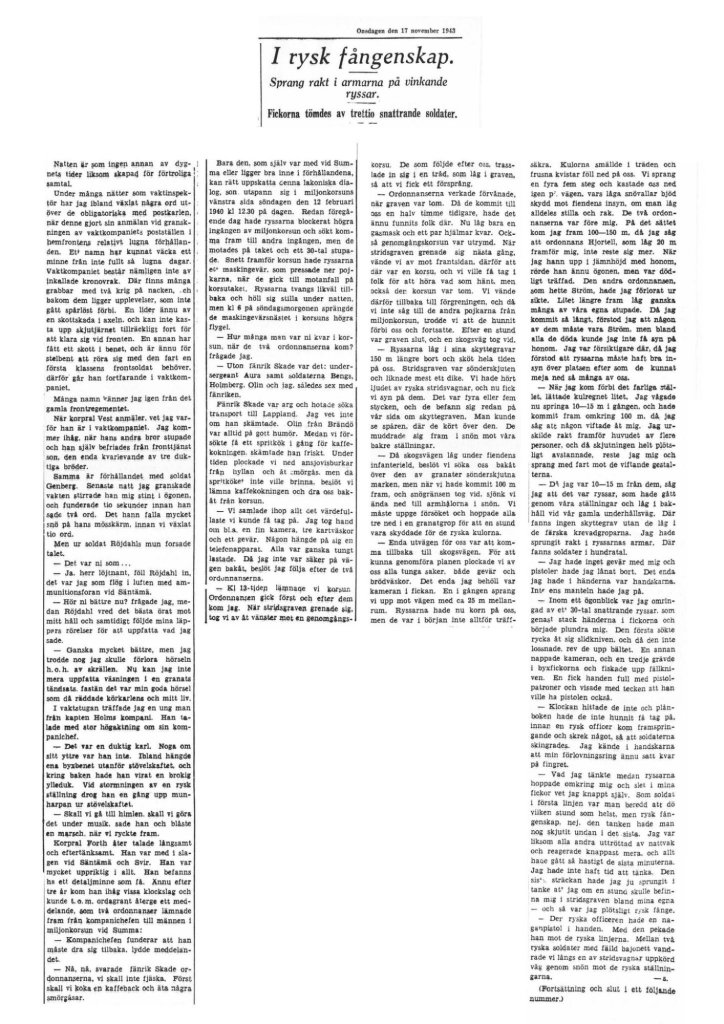
Transport east took thirteen days. The subtitle of the third Vasabladet article says it plainly: thirteen days east in an oxcart, dry bread, half-dark, a tin cup of water as daily rations.
The route went through Leningrad and Viborg.
Kornilov’s monastery
Before the Winter War, the NKVD had identified an old monastery complex near Gryazovets – the Korniliyevo-Komelsky monastery in Vologda Oblast, 47 kilometers south of Vologda – as the main camp for Finnish POWs. They had planned for up to 25,000 prisoners across nine camps. The whole war produced fewer than 900.
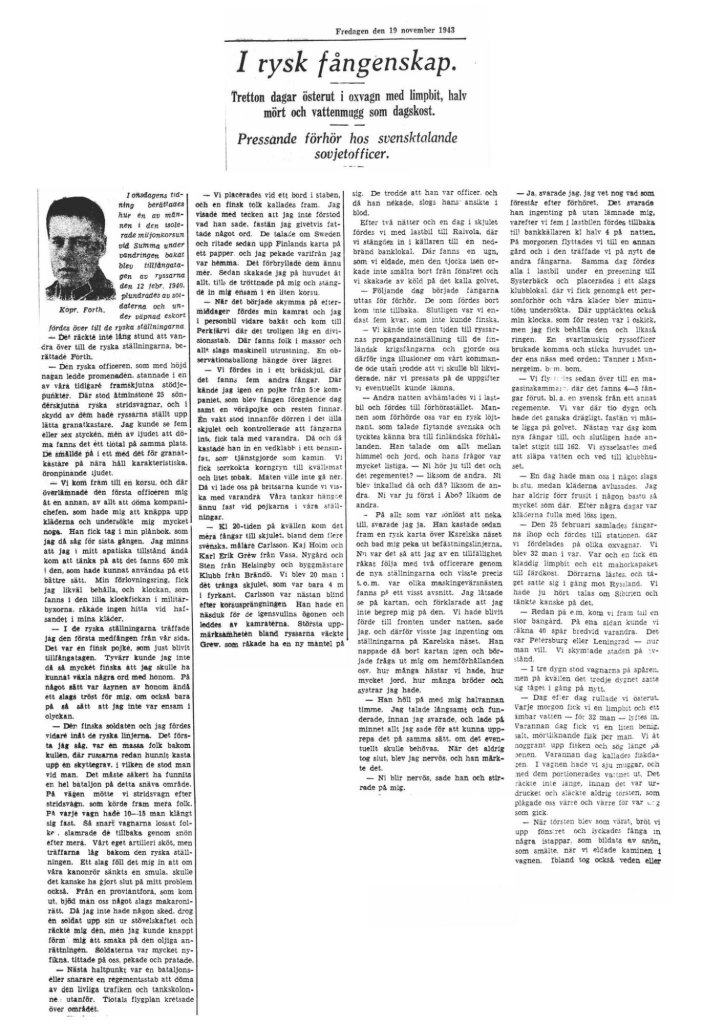
About 600 Finnish POWs ended up at Gryazovets. Rafael was one of them. The November 21 Vasabladet article carries the subheading Kornilovs kloster, där kyrkan var bastu – Kornilov’s monastery, where the church was a sauna. The monastery had been dissolved in 1924. What was left of it had been repurposed: the camp was 300 meters long and 150 wide, barracks, guardhouse, watchtowers, barbed wire.
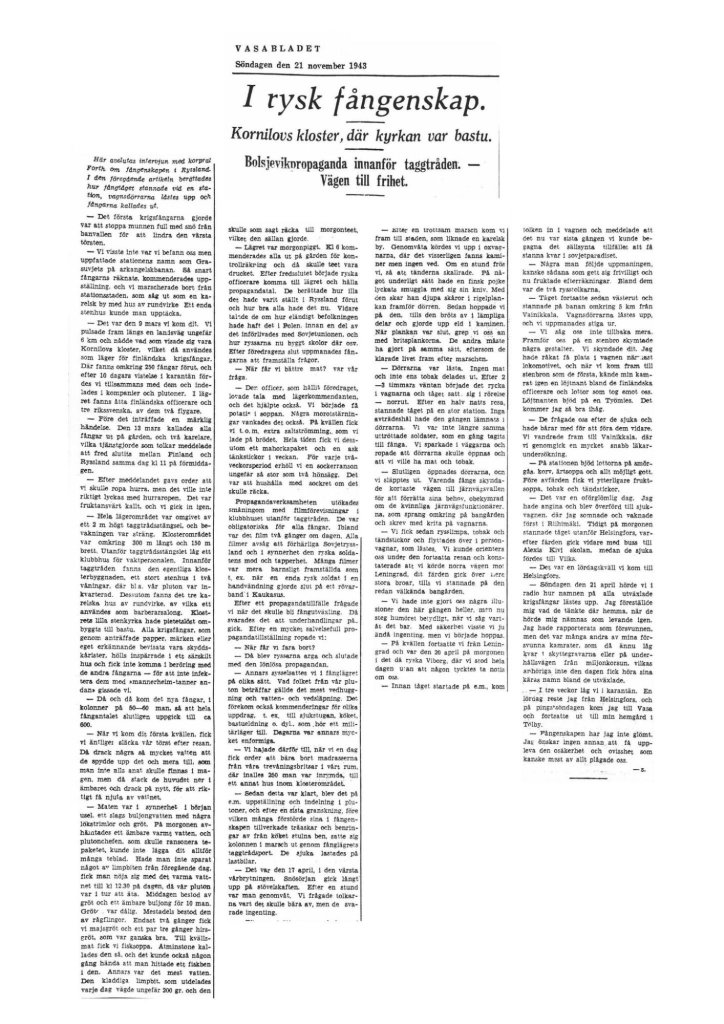
The daily program was propaganda. Mandatory film screenings. Lectures on the Soviet system. Food was gruel, broth with onion, occasional fish. Salt once a week. POWs returning to Finland weighed between 38 and 52 kilos.
The Soviet propaganda effort largely failed with the Winter War Finns. You can see it in Rafael’s account. He listened, didn’t react, went back to his bunk. He wasn’t a hero about it – that’s just what everyone did.
April 20, 1940
The Moscow Peace Treaty was signed March 13. The last group of Finnish POWs left Russia on April 20, 1940. That’s the date recorded in the Sotapolku.fi military database for Rafael Forth: captivity ended April 20, 1940. He had been a prisoner for 68 days.
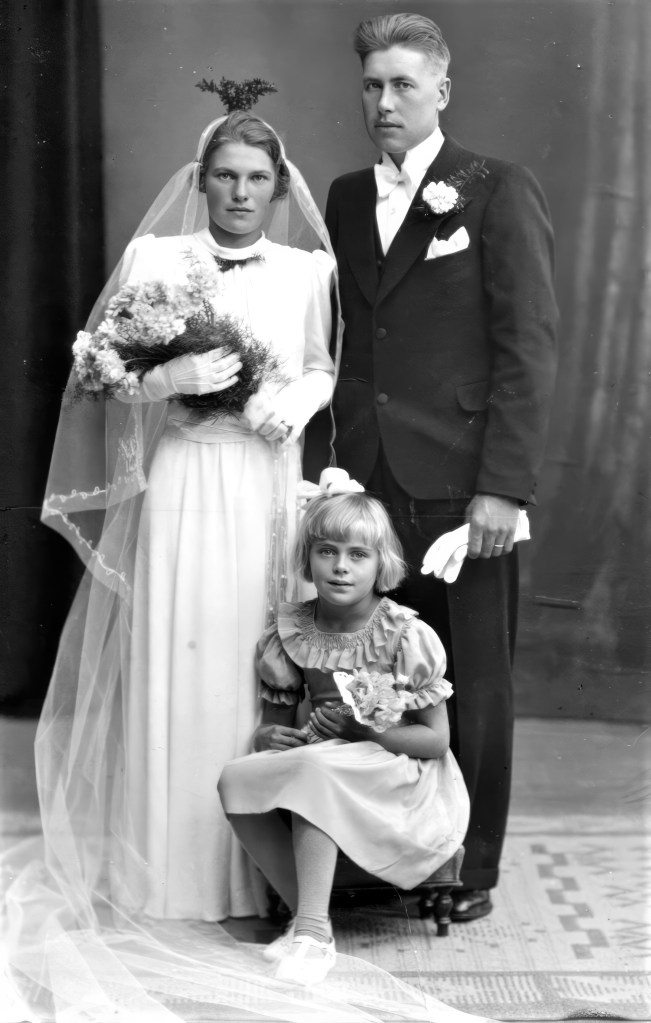
He came home to Korsholm. He married Anna Elisabet Thölix, born 1916. They had three children: Bengt Carl-Erik in 1946, Berit Ulla-Maj in 1948, and Holger Ingmar Johannes in 1951. Rafael died in 1989. Anna in 2010.
Bengt Carl-Erik is my father.
Why this exists
The Vasabladet series was published in November 1943, in the middle of the Continuation War. The timing wasn’t accidental. It was published to show that Finnish soldiers didn’t break in Soviet captivity. Rafael gave them that story. He told it without drama, and without taking any of it back.
He was 28 when the articles came out. He had a whole life left. He never, as far as I know, talked about it much.
Sources: Vasabladet November 17, 19 and 21, 1943; Sotapolku.fi; Tölby Hembygdsförening archive (tolbyhf.sou.fi); Wikipedia – Finnish prisoners of war in the Soviet Union.


Leave a Reply